Showing posts with label Ranting. Show all posts

Sunday, October 7, 2018

Behold...The System!

Not sure that's a good title, but I'm home for a few days because I've been coughing. I was supposed to run the 'Yon today, but had to cancel. I thought this would be a good time to talk about My System. A venue will ultimately shape the content, this has been written about by David Byrne in his book "How Music Works". As the format by which music was created and listened to changed, so did the kind of music that was made. For example, before there were recordings, listening to music was a small social affair, people would play the piano and sing. Initially, Edison's phonograph came with blank cylinders to record your own music. However, it didn't take long for a performance by an expert performer to be recorded and suddenly there was a market to listen to a specific recording. The nature of music performance and listening changed overnight to adapt to the new technology.

Fig. 1 The two methods compared
Pencil and paper games have been beholden to the 8 1/2 x 11 printed format. This format is great for printing and binding to be sold at mass. However, I have found the nature of bound and printed adventures for games makes them inherently linear. I have also run things off a computer, this can alter the "railroad" style of play, but there are other issues. With this in mind I have created my own system. In figure 1 (above), is the traditional version on the left and My System on the right. The traditional version pretty much resides on 8 1/2 x 11 books and paper that live in files. These go into portable file containers. Add to this all the other junk you need, dice, pencils, screens, mats and miniatures and you have a lot of stuff to haul. These plastic bins are an upgrade for my Con gaming, I can almost get everything moved in two trips.

Fig.2 My System
I want to be able to carry it all in one go. Call me OCD, but I found by forcing myself to edit down to  the essentials clears out weeds in your thinking. There is 3x the information in these boxes than in the two larger bins. This unit is designed to fit in a large soft cloth bag for easy transport. The modular boxes of cards stack like bricks on a wooden base for support. One unit, one trip.

Fig. 3 Boxes
Each box has a place for a label, the lid is put underneath to not get lost or take up space. Space in gaming is a big deal, no matter how much you fight it, every flat space in a 25 foot radius will have stuff on it. All "loose" parts of My System are designed to get folded in and not waste any space.

Fig. 4 Box is also a card holder
These boxes are custom made to hold two stacks of 4 1/4 x 5 1/2 cards. There is an insert in each so the box can also be used as a file index. This box has 6 complete adventures inside.

Fig. 5 Half sized boxes for dice
There are two shorty boxes for dice, markers and writing implements. I was originally going to put this stuff into a standard box, but the depth meant digging through layers. Wasteful and inefficient, especially if you are running at a con. The small units allow stacking (even when open) and allow everything to be visible. I see you shaking your head. Oh, there's more.

Fig. 6 Cards are 5 1/2 x 4 1/4
Sorry, had to get a cough drop. OK, here is what determined all the other sizes, the cards. A couple of years ago I stopped designing my stuff on 8 1/2 x 11 sheets of paper. The initial reason was that it was hard to make changes and slotting it all into the narrative format struck me as restrictive. I looked at standard card sizes, the problem was they are all thin paper and you cant put them through your printer easily.
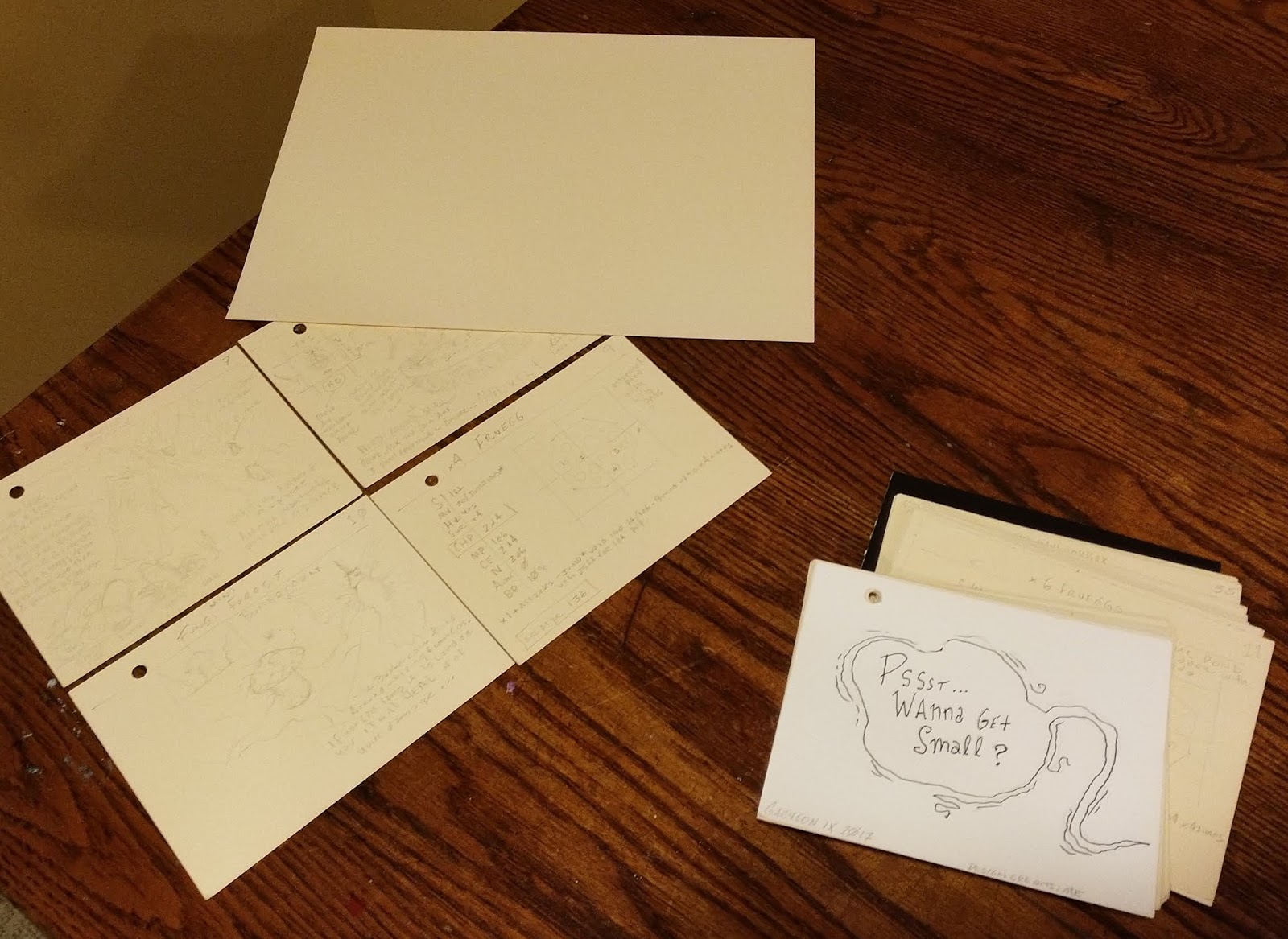
Fig. 7 Card stock source
I found a source on Amazon for 8 1/2 x 11 card stock sheets (the same used on vanilla file folders). These are cut into quarters to become my basic 5 1/2 x 4 1/4 cards. I use a paper cutter to mass cut them into stacks. It takes a while to go through them, so it's not a big deal. By using these cards I discovered other benefits. First, designing on a small card is a good way to design just one thing. One item, one room, one trap, one event. Very rarely do you need two or more cards. You end up with a system where you know each card is about one idea. Additionally, if you change the idea, rewrite on a new card and swap with the old one. Way easier to make changes. The cards are less intimidating, so it's easier to fill them up. The design process is easier. I do a lot of traveling (train, aircraft), these take up less space so it's much easier to work on a crypt crammed in between other passengers. During play cards can be pulled out as needed for reference. I punch a hole in the upper left corner to hold them together, depending (figure 6, above). The system is meant to be flexible. 

Fig. 8 Base module
The card board is not strong enough to work in a soft bag, there needed to be a support base. The base is custom made to nest two of the boxes on top. Stuff that is lager than the boxes go in here.

Fig. 9 Base contents
The top is clear plastic. Mainly what's in here are my screen and mat. These are all custom built.

Fig 10. The mat
The complete mat is dry erase. Each square is 8 x 8 inches. At 1 inch equals 5 feet, this covers 120 x 120 feet. The squares can be rearranged as needed.

Fig. 11 Ugly markers
I disdain fancy miniatures. they take up a lot of space and weaken the use of the groups collective imagination. The cubes are the player markers, the wooden lotto discs are creepazoids. You can buy old Lotto games on Ebay for a few bucks.

Fig 12. Magnetic screen
I have done much to improve my screen. You really need to think about it's function. Those big fortress like things with charts on them become a barrier between you and the players. My goal is to be as actively engaged as possible at all times. Engagement is the heart of my games. (There are a number of older posts on screens). 

Fig 13. Metal sheet
This screen has gone thru a lot of revs. The flat parts are sheets of ferrous metal cut to size. The edges and corners are filed down.

Fig 14. Magnets
The supports are wood, there are pressed in magnets in various spots.

Fig 15. Ease of construction
Building the screen is a snap.

Fig 16. Simple construction
Various elements are put together to make a card holder just big enough to keep things hidden. I also found that having two or three "mini" screens worked better than one big one. 
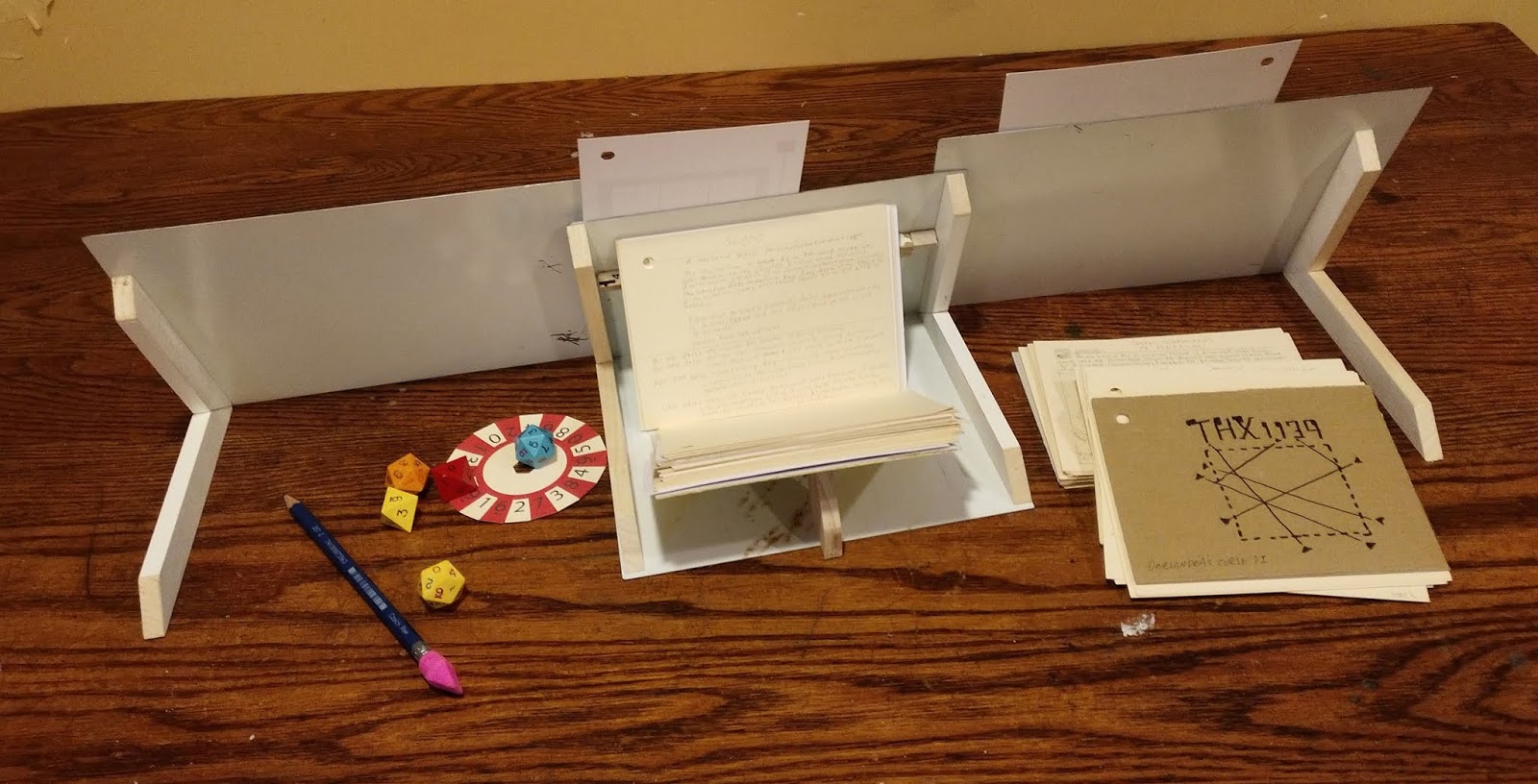
Fig 17. The whole enchilada
There are two more supports to add on two more panels. This is the Referee's view. Things can be picked up and moved around at will.

Fig 18. Front
The player side is basically a big refrigerator. Game aids and pics can be removed from the system and stuck to the front using magnets. I have been using this for the last two years and this system has really changed how I play. Hopefully I'll not be sick soon so I can get back to running some games!

Fig 19. A game from a few weeks back.
Note the SYSTEM in use (lower left)


Wednesday, April 25, 2018

Ready Player One Review Five Years Too Late But Whatever


I saw RP1 last  week. It’s a good film, watchable, over-hyped for sure. It’s a little above the level of Jumanji and Rampage, both of which I also enjoyed. It’s all about expectations. 


So, take a look at this. Well, the trick is not to look. All I recall was, looking is bad. See, look, it’s one of the nice devil mirrors from the dreaded S1. Or demon? Daemon? Is that a burning Styx album?

Last week I got to talking with Grace about the movie and she wanted to know if I knew about the “Tomb of Acer...ekk..whatever his name is”. It’s a ruse. When you meet him...never-mind. Yup. I even have a copy. Usually at this point is when the person to whom you are talking to "hears their mom calling" (Pre-internet texting). Instead I got “Can I borrow it?” Poor girl. 

It was at this point I started talking. Kinda like when my wife makes fun of me about recounting dungeon adventures as if they were something that happened in real life. Not only did I have it, It was the first D&D dungeon I played it in ‘78 and could probably go on and on and on (until I froth at the mouth and fall over backwards). So I talked. Grace is pretty hardy and fairly tolerant. Poor girl.

Next I was asked if I had read “Ready Player One”. I had not. I was informed that I needed to. It appeared on my workbench the following day with a vintage Barbie bookmark informing me I had better read this or die. Well, not “die-die” but the a kind of death a friend can conjure up with soft cushions and Barry Manilow (why wasn’t HE in the book?). My next book in the queue is about the slow disintegration of the Soviet Union in the mid 1990’s. No cushions or Barry needed to start this one.

I began on a Wednesday and finished on Sunday. Saturday I forced myself to read more slowly, once it’s gone, it’s gone. I like the feeling of fighting the whirlpool when reading a story like this. Way way way better than the film. Reminded me of reading Twilight and the Stainless Steel Rat. 

This book is constructed from the trash heap of 80’s pop (and sub-pop) culture. I have a vague memory of passing through that time, some of it brought a scrunchy face, some a gnashing of teeth. Cline handles going through the trash heap well. He stays his temptation to really geek out and keeps the writing focused on the teen boy angsty plot. Getting down into the pop culture weeds has a way of culling out a lot of readers who are just not interested in the fact that you get teleported to a misty room naked. (So, do you like gladiator movies?”)

The non-virtual world in the movie seemed flat to me. In the book it’s more real and is a proper contrast to the digital fantasy. The grayness of the world, it’s blandness, even the dull way one of the characters dies all works. The plot is fast moving and has balls. I believed in Wade's do anything to impress the girl thing. It’s the kind of thing that makes sense when your an 18 year old virgin.

I half believed I was one of the characters in the book (not one of the stupid kids, BTW). I remembered how I sat in front of the TV with my tape recorder to record Gilligan's Island. I am a purger now, a destroyer, I just don’t have reverence for old unchanging crap anymore. Where are the new ideas? I digress.


The book is a celebration of social gaming: “...As I learned more about how these early role-playing games worked I realized that a D&D module was the primitive equivalent of a quest in the OASIS. And D&D characters were just like avatars. In a way, these old role-playing games had been the first virtual-reality simulations, created created long before computers were powerful enough to do the job. In those days, if you wanted to escape to another world, you had to create it yourself, using your brain, some paper, pencils, dice and a few rule-books. This realization kind of blew my mind…”

On the back cover is a pic of the author sitting on his Delorean. I can still remember seeing one back in the 80’s at a local shopping mall with my dad. ”What a piece of junk…”

So, don't thank me, thank Grace.
Read this book or I’ll be forced to get the soft cushions out.

Remember, we are all standing on the shoulders of giants:


Sunday, April 8, 2018

How to play RPGs Real Good Part 2: Referees, Basement Leaders and Crypt Lords


Your role is multitudinous and profound. It’s tedious and dull. It’s cosmic and mundane. You are the killer of pencils, mangler of accents, appropriator of ideas, nerd wrangler and setter of the final percentage. These are my thoughts on how to be a better Basement Leader:

1) The rules should ooze from your pores. No one should be able to discern where you end and the rules begin. You are the one behind the curtain who pulls the right lever at the right time. Imagine the great and powerful Oz saying “...wait a moment while I check...page 43….hang on, illness….idiocy...ah, here it is illusion”. This is the sort of rampant sloppiness of lesser beings! Slogging through game mechanics during play makes the game run like a glitchy Tom & Jerry cartoon streaming through an old dial up modem. A referee who waits to learn the mundane workings of the rules while running the adventure is shameful indeed! They are not worthy of the term "master". Learn the rules beforehand!

2) Know your adventure. Imprint the logic of the adventure way down into your reptilian brain. This is key, because it’s impossible to document for every action the players may take in advance. Even so, creating such a vast archive would be tedious and wasteful. Record only the data you need to keep things flowing. This deep understanding will free you from the tyranny of the written key. I am completely against those prepackaged text boxes that appeared in so many TSR modules. You embrace the dullest of dooms by reading these. Sure, they are convenient, but they encourage you to understand nothing. Any creative thoughts you may have had will be whitewashed. By understanding the logic you can describe what players are seeing in a much more fluid and interesting way. This is one of the reasons why I use drawings and bullet points as my key. The images are rich with detail and have be described, bullet points let me know what is really important upon first contact with that area or event. Players will pick up on whether you are engaged or reading pre-written descriptions. Because they know you have a deep understanding of what’s going on, players will exercise their agency. Just be sure to jot down anything you create of consequence for future reference. 

3) I hate the term NPC. Non player character is not unlike a government acronym where by definition something is defined by naming it what it is not. It’s an artifact from the original D&D, in which non player “henchmen” were created to be used as pack animals and fodder to test a situation deemed too dangerous for your real character. Applying this worn out term devalues your participation in the game. Since when is a persona you are playing a “non” character? Your personas, whether selling a bauble, ordering an execution or hiding in a shadow are equally important to the narrative. They are your voice, your hand, your thoughts. Commonly accepted ideas should always be held suspect until tested as useful. There are so many lame “rules of thumb” and “common sense” notions hidden in plain sight. Change the language and you change the game. How about “In-Game Persona”? Anything is better than NPC.

4) Talk like a fool.  Elocution is the quickest way to bring your creations to life. Try out the high pitched whine of the effete warlock or the giggling cuteness of a twitching psychopath. Ever wanted to talk like Peter Lorre on an opium kick? Now is your chance! As I  create In-Game Persona’s I always note how they will sound: “Jessica Rabbit” or “Sam the Eagle” or “Paul Lynde”. This becomes a starting point when I start to talk like that character for the first time. I am always surprised how entertaining it is.

5) Be impartial. You simply must be as fair as possible. Strangely, RPG games illicit the old “Dungeon Master versus the Players” paradigm, as if every creature under the referee’s control should act as one mind to hunt down and expunge the players. I have experienced a few of these and while charming in their own way, the blood lust hollows pretty quickly. The game setting should be experienced as neutral and react to player inputs thusly. Otherwise players will feel they have no agency and will stick to solving problems using the dull solutions already built into the game. Impartiality rewards clever players because they know “the game is not out to get them”. Being impartial also means to let random things happen, things that  don’t seem to fit what you thought the story was. You need these external inputs to shake up the your thinking. If everything is always coming out of your head the game will start becoming predictable. Random mutations is a mechanism that forces you to evolve. This is one reason why a good game system has lots of tables to generate random characters, events and so on. They give you a starting point for something that you would not have created. Using these things exposes you to a new ideas. 

6) Players should have an idea what they are getting into: This gets at the heart of a couple of things, game balance and player agency. Consider: If you subscribe to the concept of “game balance” your players will know that for every situation they find themselves in, they have been matched up evenly to whatever the challenge is. Where is the agency in that? Discerning the danger level of a situation and then making choices on what to do is where all the excitement is. If they know everything is balanced, it really makes no difference what they choose. Think how Lord of the Rings would be with balanced encounters. Once the players realize that a decision could lead to a truly deadly encounter, they will definitely be more engaged because they know their decisions matter. This means they need to be able to figure out what the risk level is. As referee you will need to describe the game state in such a way so as to not hand them too much information on a silver platter. You should be unbiased, so if they ask smart questions they can figure it out. This kind of play creates a lot of excitement and you will marvel at the solutions they come up with. Sounds scary, but wait until you see the glee on their faces as they willingly choose to embrace doom!

7) No exit signs: Do not figure out the solution to an adventure in advance. If the thing you have made has one specific solution, then you have to make sure they stay on that track in order to solve it. If they have to follow that particular track, then where is the surprise? A game that is predestined, is not interesting. The excitement of a narrative unfolding is the uncertainty. Coming up with solutions is their job anyway. This does not mean the adventure should be unsolvable or that there are not useful things in it for them to exploit, it just means that you haven’t connected the dots for them.

8) A game session is made up of little bits.  These bits are sometimes called “atoms” and are a short sequence of actions that make up an event within the gaming session. They should not be treated as throw away things. RPG’s are by their nature made up of details and often they don’t always seem to fit neatly together. This is actually desirable, because if everything is meshing too well, that means the agency of the game has probably been compromised. The narrative is constructed from all these little bits. Seemingly unrelated bits become connected with one another simply by being together. For this to happen they all need to be treated the same. Think about how some random detail in a Sherlock case suddenly becomes important. Or how a strange coincidence suddenly changes the story. These seeds are here in the details whether they are contrived or random.

9) Serve up equal slices of pie. Sweep from one end of the table to the other continuously and make sure everyone gets an equal chance to do something. Don’t let loudest people suck up more than their fair share of your attention. By constantly sweeping back and forth from one player to the next you can make sure everyone gets to do something. During combat this is easy as game mechanics pretty much resemble a turn based game at this point. But also get in the habit of doing it all thru the game. There is always a quiet one in the back...the crazy one who is going to take a bite of that unidentified mushroom, jump up on the creepazoids back and get this party started!

10) Own your weakness: I suck at making things up on the fly. And I get flustered sometimes. So I prepare beforehand by creating a bunch random junk that I might need. It’s not much, a few lines, but it seems to be enough. The flustered thing, when I feel it coming I’ll excuse myself for a minute or two and think about bowling or something. Weakness is a reminder to not take your eye off the ball. Weakness is strength. I think that’s carved on a ministry somewhere. 

11) Keep up the pace. As basement leader it’s up to you to manage the time flow. You are the director making sure the production is moving along at the right speed. Watch just about any action movie from the 70’s and you will know what I mean. Do we really have to watch someone get into their car and drive for 8 minutes? Time is plastic, so the unimportant stuff can be summarized in a quick sentence or two. Keep things moving at a rate that is consistent with the players actions and the what is going on. This doesn’t mean that everything should be moving real fast all the time, sometimes things deserve to be stretched out to fully enjoy their impact. Like the oozing of nearly coagulated blood down the pitted face of a giant skull right before it...you get the idea.

12) Meta-Gaming: This whole idea that players can only act within their characters in-game knowledge is total BS. It is the most anal way to suck the fun out playing RPG’s. “Metagaming” is the fun real world social interaction that happens when players talk to one another. This is where the jokes are, the irony, begging/cajoling someone to do/not do  something. This is the reason why we are here. Limiting players to what their personas only know in the game will turn your social interaction party into a tedious tactical miniatures game. Somehow anti-metagamers believe RPG’s are quantifiable like a real game. That the player with the highest xp, money, power, is comparable to a basketball player. RPG’s are not games the same way basketball is. The rules of basketball do not arbitrarily change. Basketball players are not allowed to attempt any action to score points. Even the idea of what winning means are not in sync. “Metagaming” is equated with cheating, which is absurd. How can there be cheating in a game in which the referee can instantly change things, often times without the players even knowing it? I mean OMFG. I am out of breath. Phew. Idiots.

13) Anything may be attempted. This is the most unique thing that RPG’s have over any other game experience. Players have the freedom to attempt any action and you then decide what the chances of it working will be. This is the essence of RPG’s and why they are so  compelling. For some referees, when players try unusual stuff (which can push against the boundaries of the game system) they get a little nervous. This is OK, roll with it and work out a way to that allows the action to be attempted. A simple die roll is the easiest. The crux here is to let them try stuff. Otherwise the single most powerful aspect of role playing is lost.

14) You are not responsible for all the fun. It’s up to you to prepare the adventure beforehand. Dice have to polished. Chairs reinforced. Never mind all the complex referee stuff you need to attend to while play is in progress. Snacks must be arranged alphabetically. It’s a lot. It would seem logical then that you are also responsible for all the fun. You are not. Being part of an RPG game is a collaboration between everyone present. The players have things they need to do (see How to play RPGs Real Good Part I: Players), one of them is to get off their lazy behinds and play the game well.

Cheers!

Friday, April 6, 2018

Abismal Pit of Hell D&D Adventure 1980's by "The Big Toe"

Here is another adventure from the days of yore:


TBT uses a similar method I use to document adventures...drawing pictures. They are a better shorthand and way better than reading through a text block. You have to describe in your own words...hugely important in word based games.


Here is a sample of the words.It's amazing how little you need to run an adventure, really.

Grribgigrt, the main "In Game Persona" (More on this in a later post).

Frog Castle. Duh.

More descriptive stuff. Imagine describing this all in words...the picture is so much more efficient.
The whole point I think is to show the stuff, the hidden stuff that the players never see in this way. To show that...I guess you sit down and just do it. This is what it looks like. Words. Pictures. Some ideas. A few stats. 

The Big Toe is going to be mad. Maybe he will shed some light on all this in the comments. He's skulking out there somewhere ready to break a candy glass bottle over your head. Or accidentally break your Magna Doodle. Do you know how hard these things are to break?

Oh, here is the PDF of "The Abismal Pit Of Hell":

BTW, there is some Gama World stuff rolled into this adventure. I really hated it when the nice people at TSR decided to "Standardize" everything. Magic AND science? If we put them in one game they will just buy one instead of two...


Tuesday, March 27, 2018

Mike the Mangler's "Kananas Abode" 1979

Here is another infamous dungeon created by my best friend: The Mangler. We played through this time and time again in his bedroom in beautiful Milan Illinois (pronounced my-lan). There are several extraordinary things about this adventure.


First, check out it's colorfully insane Soviet/Disney Princess fascade. Remember, dungeons were all underground at this time and to get in you schlepped down the ol' staircase. Mike has flipped the whole thing, in just about every way. Above ground instead of under. Bright bold color instead of dungeon grays and khakis. You have multiple ways to get inside, instead of the one stairway down. It's also fun and inviting instead of dank and depressing like...well a dungeon.


Mike also drew a lot of these, he had issues with smiley faces. He is also probably one of the first real cosplayers in the world. He had a full Alex get-up from Clockwork Orange- boots, bowler, codpiece, eyelash and yes a real sword cane.


Mike was a Dungeon Master who did not make or keep real notes, he pretty much just winged the whole thing. I have always been envious of those people. He was big on the interpersonal relationships of all the characters, he essentially ran the game like a big soap opera. Genius, really. Going through Kananas Abode was more like making a trip to the supermarket to get some milk. In other words, it wasn't just a "one and done', it was a node in the whole scheme of things that required many visits to work out what ever was going on between us players and Kananas. The scribbles seem ridiculous, but I bet it's just the right amount of information. Plus it gives the DM room to make stuff up and get in on the fun.

Here is a link to a 2 page PDF of the whole shebang: https://drive.google.com/open?id=1-dUztgIDp3GvUckC7SOXuWooy4Vw3uuR

The whole thing is all in bits and pieces, like emptying your pockets before going into prison.  I took the initiative and pasted it all into a two page excursion into The Madness Of Teen 1979. Looking at Kananas Abode, I can see what D&D lost and why I jumped off the flaming wreck with all the other rats. Well, all two rats. OK, it was just me. And the fire wasn't an accident.


Thanks Mike.
I'm glad I saved it, but even more glad to banged on Kananas locked tower door more than once.


Monday, March 12, 2018

I Guess I Have To Write About Gary Con X

Ok, I  went to this event, so I guess I should write a word or two. I signed up to run 20 hours of games. On Friday from noon to four I ran "The Towering Inferno of Death II" for these people:


My friend also showed and someone's mom who never played any games before also played. A total of eight peeps. (one of them was a girl, she left the table to change her outfit). They rode a giant tongue, had a conversation with a pool of living blood and answered all eight of the Megamumu's questions.


On the next day, from noon to four I ran another group of people through yet another event, called "You Break It, You Bought It". My friend's friend showed up with his daughters. This event wrapped when one of the players was able to get his toes cleaned by a cyber laser cat from another dimension.


Here is one of the many non-persona characters they met.

So, after two complete days, fifteen newbies played CNC. This would mean my fan base exploded by a 25%!

A hearty THANKS to all those who played! Without all of you my endeavors would just be...you know. I'll be at the event next year to run more games!

All the stupid stuff was expunged...not sure what I was thinking. Funny? Notsomuch.


Monday, January 29, 2018

Get Your Asbestos Shirty! Towering Inferno Returns to Gary Con X


Can you survive the Towering Inferno of Death II?

Time to get your asbestos shirty and greet the Monks of Murkey! A lucky few are chosen to test themselves in this gauntlet of flaming ultra-violence. Will you survive or become a high grade fertilizer? This smoking hot adventure is set in the schwartzpunk fantasy system of Crypts-N-Creepies and open to all makes of players.


Here is one of the eight pre-generated personas.


Possible event from adventure.


Monk of Murkey showing wares. I can say no more.


The event schedule. WHAT ARE YOU WAITING FOR?
I PROMISE if you do not have fun I will beat myself with a stick*.

Tuesday, July 18, 2017

My AD&D "Cyclops Of Yew" Dungeon Circa 1979


This was one of my fancier dungeons, probably based on Tomb Of Horrors. OK, definitely based on TOH. I have no idea where would have gotten this parchment paper to type on. Stolen from my dad's dresser? After TOH, I knew creating a riddle to give to my friends at the start was the ticket. It generated anticipation and provided logic to avoid the traps.


I had a set of colored fine tip markers (an X-mas present) that I used to make all my maps. This was always my favorite part. Cool Map = Cool Adventure.


My spelling is still atrocious.


A nice snap of me in that dreaded year. I hated the 70's. I listened to Zappa and...apparently wore bad cloths. To be fair...well, never mind. On my right is the infamous "Mike the Mangler". During one of the games he DM'ed we planned an assassination while he listened. When we carried it out there were suddenly new guards and procedures that meshed perfectly to foil our plan. From that point forward we would make him leave the room any time we made plans. 

You can find the whole "Cyclops Of Yew" here: https://drive.google.com/open?id=0B4SbN-rtbAlgZ3FnTlVMUERsZjQ

Enjoy!

Wednesday, July 12, 2017

Header Causes Quadrupeds To Burst Into Flame

Well, not really, more like a smoldering...think of the smell of burning carpet.


Process: Sort old model parts, cut them up and glue together.


Print out a background, photograph, Photoshop and viola, a header. Enjoy!
(Note, the V2 version of the rule book will be done like this)

Tuesday, July 4, 2017

Carl’s Dungeon of “Mazes of Xanth” 1978

"Mazes of Xanth" map detail
Somehow (because I am a particular sort of hoarder) I had a bunch of my friends dungeons from the late 70’s and early 80’s. This is one was created by Carl Kestor, who by the way was not really my friend, just a guy I played a few games with. The memory that bubbles to the surface about Carl is that his girlfriend would sit on his lap while he DMd. She ignored us completely. Occasionally they whispered and smooched, and when Carl had to look at one of us he had to crane his head to see past his girlfriend. I am quite sure I never asked or was told her name. I recall being mildly annoyed, in real life Carl had a “low charisma”. However, none of us could convince any girl to sit on our lap, let alone while playing a game synonymous with note taking and tedium. I raise my bag of off brand cheese puffs to you wherever you are now, Carl.

Cover page of "Mazes of Xanth"
Yes, I am older than dirt. Often I will say this to the yoots of today, thinking that I can impress them or more importantly get respect. Medication has removed this need, so I will not bore you or myself by trying to impress you with aged based credentials. Ahem.

Typical page of "Mazes of Xanth"
Look at Carl’s dungeon: It is instructive to note the sheer amount of characters carefully recorded on each page, all 16. I’m sure I didn’t write this amount in one whole year of high school, so this mass of carefully scrawled graphite is an achievement in its own right. So many words and so little actual detail in the rooms other than monster, stats and treasure. Kinda like a video game minus every scrap of enjoyment. Heed the the title itself, appropriated from a popular book series. Look at the map with its incomprehensible rooms and serpentine hallways specifically designed to discourage accurate mapping. Consider in 1978, this was considered a better alternative to the four broadcast channels on TV. And it was.
Here is a link to the whole thing:
More will be posted so “stay tuned”. That is all.