Showing posts with label Game Aids. Show all posts

Sunday, October 7, 2018

Behold...The System!

Not sure that's a good title, but I'm home for a few days because I've been coughing. I was supposed to run the 'Yon today, but had to cancel. I thought this would be a good time to talk about My System. A venue will ultimately shape the content, this has been written about by David Byrne in his book "How Music Works". As the format by which music was created and listened to changed, so did the kind of music that was made. For example, before there were recordings, listening to music was a small social affair, people would play the piano and sing. Initially, Edison's phonograph came with blank cylinders to record your own music. However, it didn't take long for a performance by an expert performer to be recorded and suddenly there was a market to listen to a specific recording. The nature of music performance and listening changed overnight to adapt to the new technology.

Fig. 1 The two methods compared
Pencil and paper games have been beholden to the 8 1/2 x 11 printed format. This format is great for printing and binding to be sold at mass. However, I have found the nature of bound and printed adventures for games makes them inherently linear. I have also run things off a computer, this can alter the "railroad" style of play, but there are other issues. With this in mind I have created my own system. In figure 1 (above), is the traditional version on the left and My System on the right. The traditional version pretty much resides on 8 1/2 x 11 books and paper that live in files. These go into portable file containers. Add to this all the other junk you need, dice, pencils, screens, mats and miniatures and you have a lot of stuff to haul. These plastic bins are an upgrade for my Con gaming, I can almost get everything moved in two trips.

Fig.2 My System
I want to be able to carry it all in one go. Call me OCD, but I found by forcing myself to edit down to  the essentials clears out weeds in your thinking. There is 3x the information in these boxes than in the two larger bins. This unit is designed to fit in a large soft cloth bag for easy transport. The modular boxes of cards stack like bricks on a wooden base for support. One unit, one trip.

Fig. 3 Boxes
Each box has a place for a label, the lid is put underneath to not get lost or take up space. Space in gaming is a big deal, no matter how much you fight it, every flat space in a 25 foot radius will have stuff on it. All "loose" parts of My System are designed to get folded in and not waste any space.

Fig. 4 Box is also a card holder
These boxes are custom made to hold two stacks of 4 1/4 x 5 1/2 cards. There is an insert in each so the box can also be used as a file index. This box has 6 complete adventures inside.

Fig. 5 Half sized boxes for dice
There are two shorty boxes for dice, markers and writing implements. I was originally going to put this stuff into a standard box, but the depth meant digging through layers. Wasteful and inefficient, especially if you are running at a con. The small units allow stacking (even when open) and allow everything to be visible. I see you shaking your head. Oh, there's more.

Fig. 6 Cards are 5 1/2 x 4 1/4
Sorry, had to get a cough drop. OK, here is what determined all the other sizes, the cards. A couple of years ago I stopped designing my stuff on 8 1/2 x 11 sheets of paper. The initial reason was that it was hard to make changes and slotting it all into the narrative format struck me as restrictive. I looked at standard card sizes, the problem was they are all thin paper and you cant put them through your printer easily.
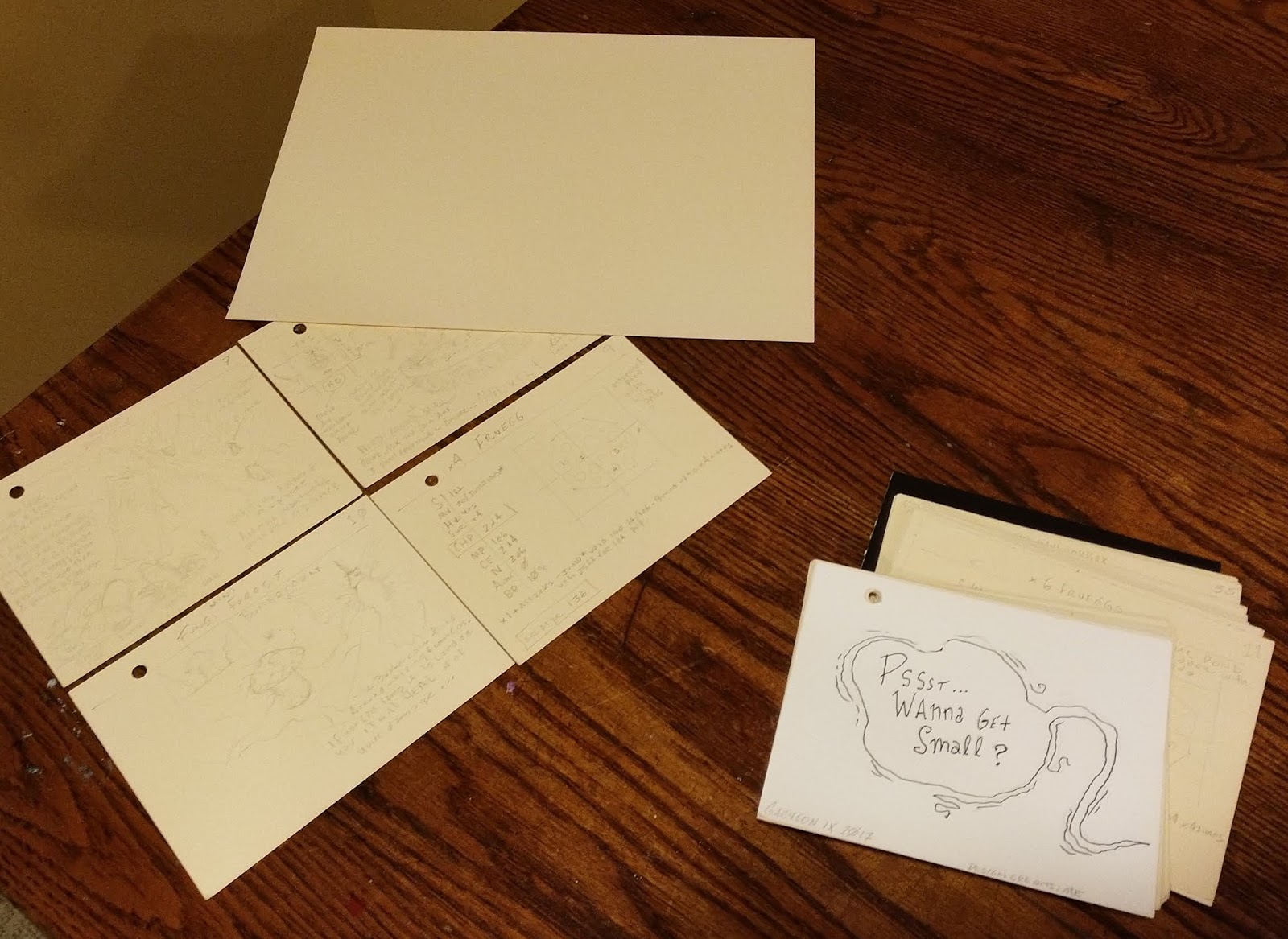
Fig. 7 Card stock source
I found a source on Amazon for 8 1/2 x 11 card stock sheets (the same used on vanilla file folders). These are cut into quarters to become my basic 5 1/2 x 4 1/4 cards. I use a paper cutter to mass cut them into stacks. It takes a while to go through them, so it's not a big deal. By using these cards I discovered other benefits. First, designing on a small card is a good way to design just one thing. One item, one room, one trap, one event. Very rarely do you need two or more cards. You end up with a system where you know each card is about one idea. Additionally, if you change the idea, rewrite on a new card and swap with the old one. Way easier to make changes. The cards are less intimidating, so it's easier to fill them up. The design process is easier. I do a lot of traveling (train, aircraft), these take up less space so it's much easier to work on a crypt crammed in between other passengers. During play cards can be pulled out as needed for reference. I punch a hole in the upper left corner to hold them together, depending (figure 6, above). The system is meant to be flexible. 

Fig. 8 Base module
The card board is not strong enough to work in a soft bag, there needed to be a support base. The base is custom made to nest two of the boxes on top. Stuff that is lager than the boxes go in here.

Fig. 9 Base contents
The top is clear plastic. Mainly what's in here are my screen and mat. These are all custom built.

Fig 10. The mat
The complete mat is dry erase. Each square is 8 x 8 inches. At 1 inch equals 5 feet, this covers 120 x 120 feet. The squares can be rearranged as needed.

Fig. 11 Ugly markers
I disdain fancy miniatures. they take up a lot of space and weaken the use of the groups collective imagination. The cubes are the player markers, the wooden lotto discs are creepazoids. You can buy old Lotto games on Ebay for a few bucks.

Fig 12. Magnetic screen
I have done much to improve my screen. You really need to think about it's function. Those big fortress like things with charts on them become a barrier between you and the players. My goal is to be as actively engaged as possible at all times. Engagement is the heart of my games. (There are a number of older posts on screens). 

Fig 13. Metal sheet
This screen has gone thru a lot of revs. The flat parts are sheets of ferrous metal cut to size. The edges and corners are filed down.

Fig 14. Magnets
The supports are wood, there are pressed in magnets in various spots.

Fig 15. Ease of construction
Building the screen is a snap.

Fig 16. Simple construction
Various elements are put together to make a card holder just big enough to keep things hidden. I also found that having two or three "mini" screens worked better than one big one. 
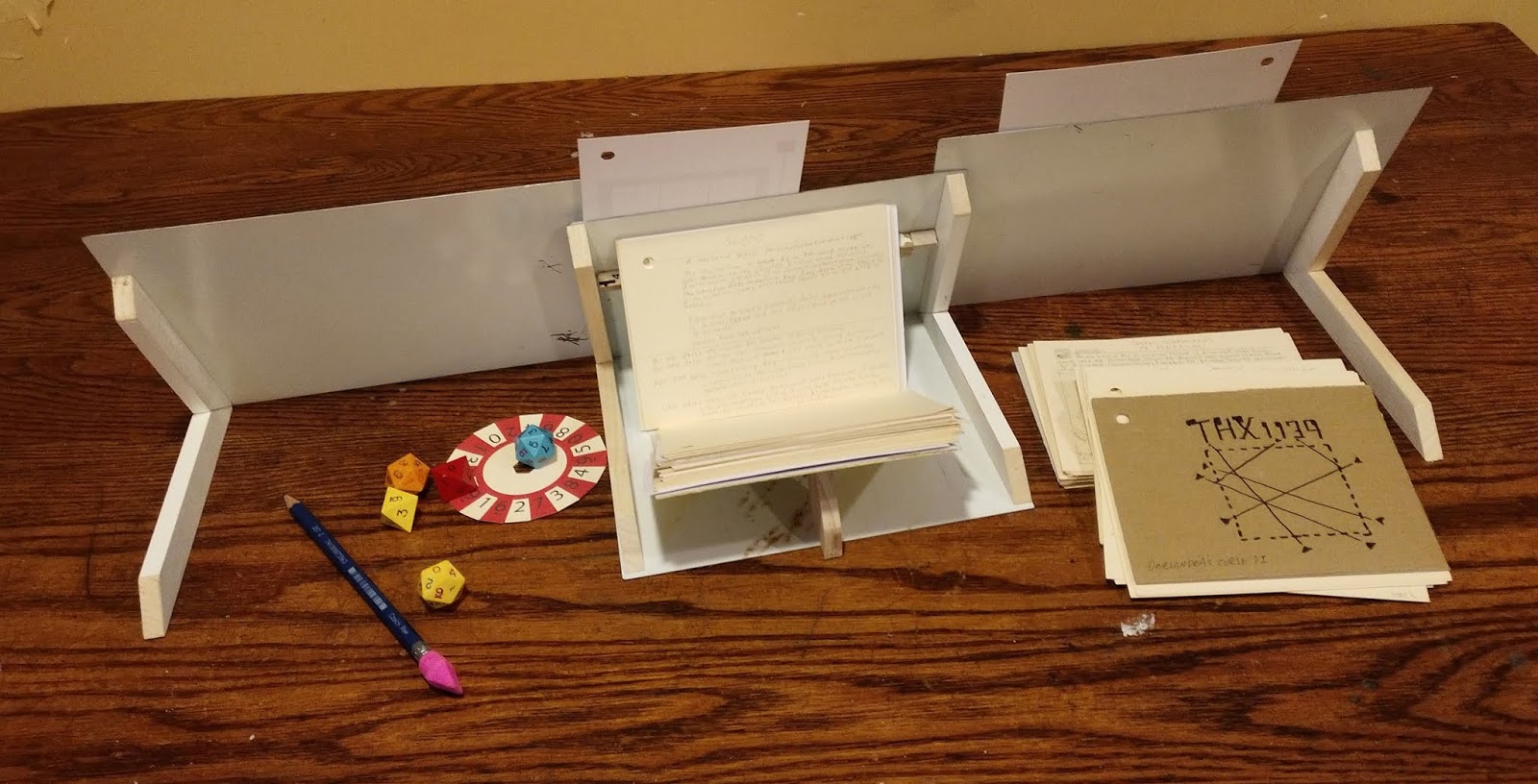
Fig 17. The whole enchilada
There are two more supports to add on two more panels. This is the Referee's view. Things can be picked up and moved around at will.

Fig 18. Front
The player side is basically a big refrigerator. Game aids and pics can be removed from the system and stuck to the front using magnets. I have been using this for the last two years and this system has really changed how I play. Hopefully I'll not be sick soon so I can get back to running some games!

Fig 19. A game from a few weeks back.
Note the SYSTEM in use (lower left)


Friday, April 6, 2018

Abismal Pit of Hell D&D Adventure 1980's by "The Big Toe"

Here is another adventure from the days of yore:


TBT uses a similar method I use to document adventures...drawing pictures. They are a better shorthand and way better than reading through a text block. You have to describe in your own words...hugely important in word based games.


Here is a sample of the words.It's amazing how little you need to run an adventure, really.

Grribgigrt, the main "In Game Persona" (More on this in a later post).

Frog Castle. Duh.

More descriptive stuff. Imagine describing this all in words...the picture is so much more efficient.
The whole point I think is to show the stuff, the hidden stuff that the players never see in this way. To show that...I guess you sit down and just do it. This is what it looks like. Words. Pictures. Some ideas. A few stats. 

The Big Toe is going to be mad. Maybe he will shed some light on all this in the comments. He's skulking out there somewhere ready to break a candy glass bottle over your head. Or accidentally break your Magna Doodle. Do you know how hard these things are to break?

Oh, here is the PDF of "The Abismal Pit Of Hell":

BTW, there is some Gama World stuff rolled into this adventure. I really hated it when the nice people at TSR decided to "Standardize" everything. Magic AND science? If we put them in one game they will just buy one instead of two...


Saturday, March 31, 2018

Svelte Magnetic Referee Screen

Years of tinkering and I hit upon this design "by mistake". 


Gaming has changed. The way I play has also changed. Less is more. I have great minis and a whole modular resin dungeon terrain system. They look fantastic. However, they are hard to set up, transport and limit participants imaginations. These days my goal is to strip away the stuff that doesn't work. This thinking has led me to look at "DM*" screens and question what they are really for.


Here is where I have been. When I started in the 70's a record album was fine (1). I took some plywood and duct tape and made my own (2). It served as a barrier and I could stick charts and stuff on the back side. A few years back I bought this thing (3), four leaves and clear pockets for all sorts of gamy minutia. This is a good solution and compact. However, I was noticing that it would sometimes actually block my view of the players. If I am roasting their character over a spit I want to see the the expression on their face, not a random foot-gear matrix. This led to the last design (4). It's shorter, and has other useful features. I have used this one for a couple of years and my biggest frustration is that it is not as portable as I would like.


This led me to conduct experiments using foam core. These days all my adventure designs are done on quarter sheets of 8.5 x 11 paper. Each card is about one idea and because they are loose you can rearrange and pull stuff out at will. (I will talk about this in a later post). The designs above are testing the concept of having several mini-screens on the table instead of one big one. Big screens are like fortresses, they get in the way and act as a barrier to intercourse. I should not have to tell you that an RPG's essential characteristic is this interaction.


So, for this mock-up the idea is that the whole mini-screen fits in an 8.5 x 11 foot print and held together using clever folds and tabs. This led to:


Folds and joints are always tricky. I found some scrap painted sheet metal (old siding, I think), cut it and finished the edges with a file. Scrap wood (from an old dresser drawer) was cut into the triangular supports.


Here's the magic: magnets. Pretty straight forward, drill hole slightly smaller and press them in. I was like "hmmm, OK".


Easy to assemble and svelte.


Like so.


The bar thingies swaddle the stack of cards so I can leaf through them. These wood strips are magnetic, so they can be infinitely adjusted relative to any size stack of cards.


I cut two more matching triangular supports and two more sheets of metal. This is the players view. The height of the larger panel is about 7 inches. Now I had a bunch of supports with magnets and metal sheet.


Everything is completely modular and reconfigurable. Let that sink in.


Using smaller magnets, any information needed could simple be added or subtracted at will.


Here the triangular supports have been turned up to make the screen steeper.

So there you have it. I'm pretty excited about this.

The older post:


I'll add this to the Nuggets & Forbidden Knowledge Tab. Tell your friends. "DK", your off the hook for a few weeks, but going to post one of your dungeons...

* "DM" is Dungeon Master. I still like this term, I was going to use "Crypt Lord" instead, but no one knows whatdahail that is except me. Someday Crypt Lord and Nimbality will be part of the common lexicon. I have not typed Crypt Lord into Google...

Cheers!

Friday, December 29, 2017

Updated Persona Sheets


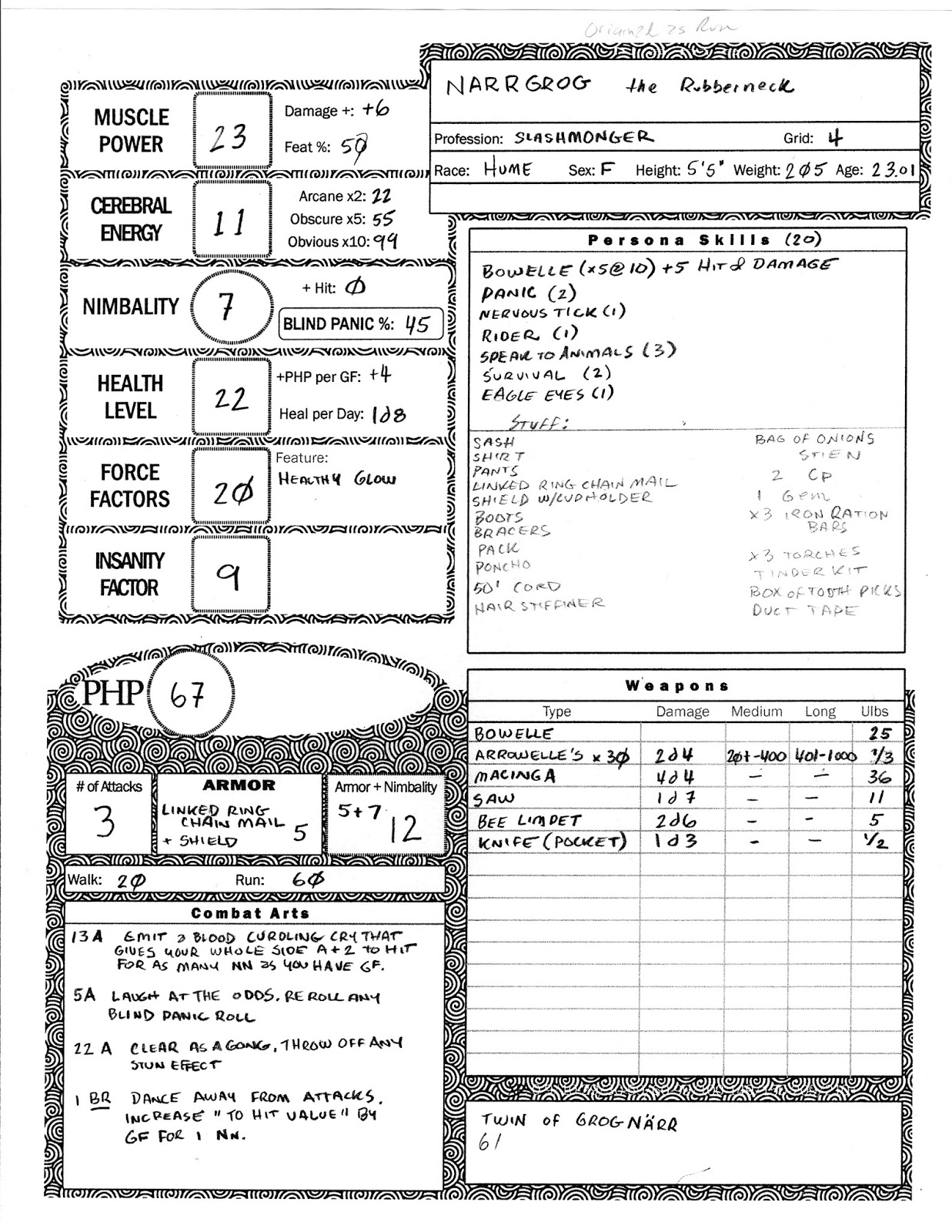
Here is the newest persona sheet for C-N-C. As the mechanics of the game evolve, so does the infrastructure to support player information. Can you judge a game by its character sheet? Download the new sheet here: https://drive.google.com/open?id=1-H6rNmE9bttwtx73XQ8msX4hQtUSijRt
For reference, here is an old sheet:


The style of the new persona sheets represent the new style presentation of the next iteration of the C-N-C rules, which will be available in 2018.


They are made as digital collages. I basically collect things that normally thrown away, photograph them, digitally cut them up and reassemble. Enjoy!

Sunday, February 5, 2017

Amazing Crypt Lord Screen

Many moons ago I posted a new ref screen, designed for more referee/player visibility. It's a great design, except that it's not very portable. Well, not any more...


Typically I carry all my stuff to some location to play. The goal it to have everything fit into two small portable files, designed to hold 8 1/2 x 11 paper. This screen has many features: 1) I made it as short as possible so everyone could see my face clearly at all times (this also works in reverse). 2) The front acts as an angled display base for illustrations, maps and notes. 3) The top edge holds dice and pencils. And now it fits into my portable file. Gaming infrastructure gets a bad rap, but when the detrimental elements of the physical process of gaming is eliminated, you are left with a better experience. 

I am still slaving away on my events for Gary Con IX. After that, there will be a more svelte version of the above screen. Eagle eyed viewers may have spotted the other big innovation in the video, it will be revealed soon!

Here is link to the ref screen post: http://crypts-n-creepies.blogspot.com/2016/01/coolest-gamemaster-screen-ever.html

Wednesday, December 14, 2016

New Way to Generate Random Stuff on the Fly

I like my dice, but sometimes they get in the way. This often happens when role playing conversations and I need to pull something off a list somewhere to spark my creativity. I have always loved that commercial where the two people walk into each other, one is eating from an open jar of peanut butter, the other munching on a chocolate bar. "Heyyy....you got your dice in my table...." 


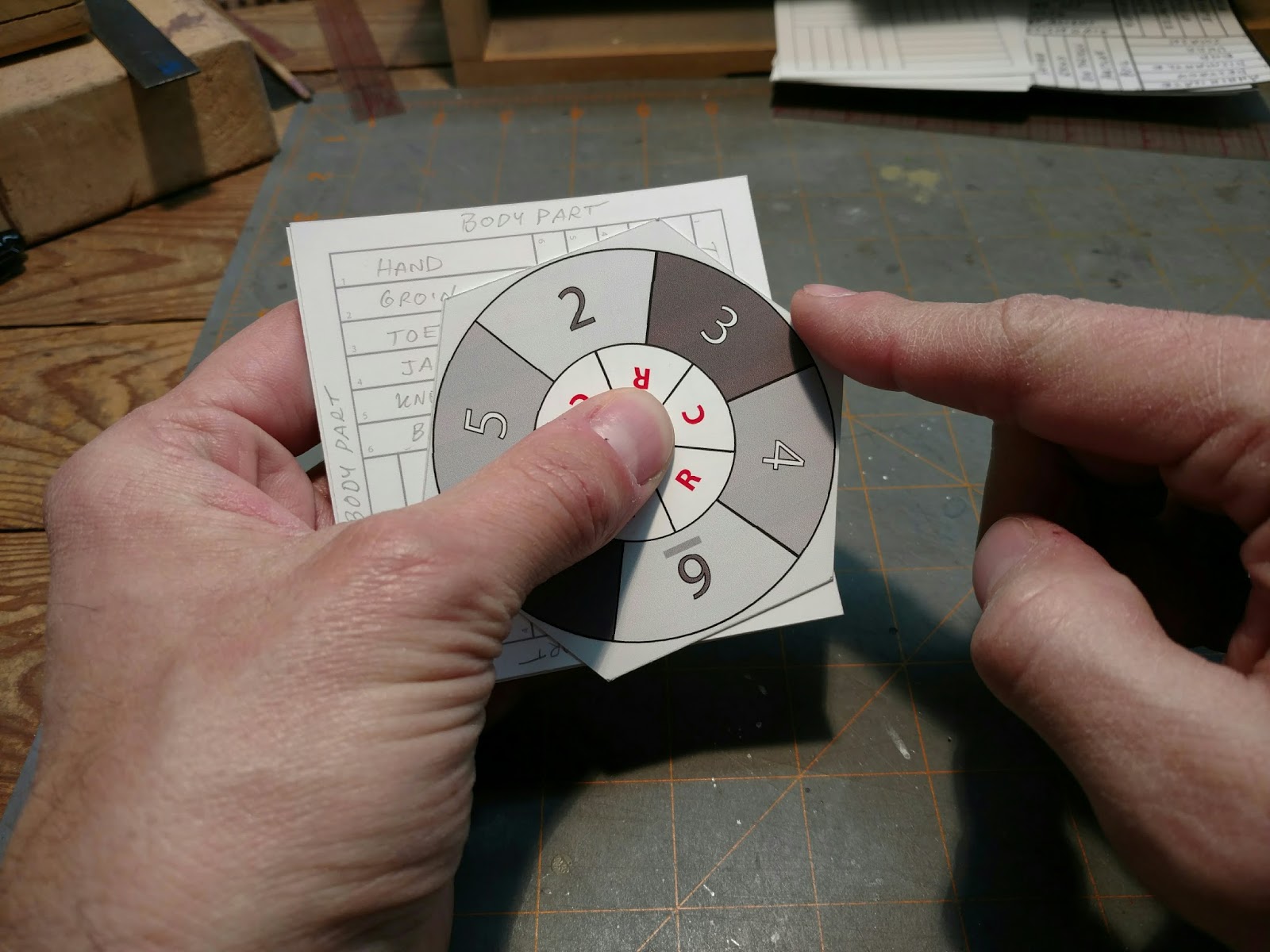
I took the listings from Mr. Sabbath's "d100 Brutalizer" post and put them on cards I printed out that look like this. His list has around 200 entries, each one of my cards holds 24. His list makes a good demonstration of this format.


Here is how they work. Spin them around so a random side is up. There is a hex shaped card on top that is broken into two rings of six zones. Rotate it and slide your thumb down. You will get a number from 1 - 6 and either an "R" or "C".

I check the hex card result, in this case a 3R, which means 3 REPEAT. I slide the cards down so the 3 slot on each is visible. I got "Barbecued Toe" as a result. Because this can be done while doing something else, (like talking) it's a seamless way to throw in random stuff during play. No flipping through books.


The original purpose was to generate random city encounters on the fly. For example, the players walk into a bar and they see...


...a Mengweer Bucklemaker who says "didn't I kill you once"?

Monday, September 12, 2016

Clogs of Poop: God's Workbench Part 5

Igor, Mundo and Chum
https://drive.google.com/open?id=0B4SbN-rtbAlgdzVodmZJeVpHcFU
I make images to create my fantasy world. Sadly the use of images in RPGs is oft reduced to the color-matched mountain landscape over the proverbial plastic-wrapped couch. It seems the default method of RPG design is the written word. Text is generated as a primary source and then an artist is rustled up to embellish the words as an afterthought. As a visually creative person this is backwards thinking. Many concepts start as images and are developed further in the same format, much like an artist’s sketchbook.

Don't be afraid to use images as a primary source. Draw your own, appropriate them, or create them in your head like Stephenie Meyer. She dreamed about a vampire glistening in the sun like diamonds which became Twilight. Tomb of Horrors would be a verbose monstrosity without images. Maze of the Blue Medusa uses images as a primary source material. Think about Da Vinci's* sketch books.

Grant Wood probably would have lived here.
https://drive.google.com/open?id=0B4SbN-rtbAlgMzgtNkJ3NmxRTVk
Let's talk about Doi. It’s just north of the Moot of Fooglie. I always imagined Doi as the world's most boring place. Much in my milieu is appropriated from our world. There was this girl I used to work who was not too bright and earned the moniker “The Duchess of Doi”. When I needed a name for this place of gently rolling fields, Doi immediately sprang to mind. Doi is not a great place to start an adventure, but to the north is Pewlon. Pewlon is home to everything magical, sparkly, rainbow colored, Zwinkies, grotto's and magic mushroom patches and so on. My players needed to get through Doi in order to reach Pewlon. So I sat down with pencil in hand and my sketchbook and started to think about this boring place. I started with a typical dwelling and imagined it to be a large communal homestead. It would be large enough for an extended family that worked the farm. I wanted the building to be a little bit more interesting, so I sketched it as a truncated mud silo with an angled roof and little triangular windows. This led to thoughts about harvesting machinery (which are common around here). What would be the equivalent in Doi? I try not to overthink it, so I sketched an enormous beast. This would become “the docile beasts of Doi”. I had created an non-player crypt opener from Doi called Hannah as an adventure hook. When it came time to write down the stuff on her equipment list one of the things she wore were traditional Doi clogs made out of hardened docile beast poop. This led to the idea of using excrement as a building material.  So, yes everyone’s house is clad in stucco made from poop. The “docile beasts of Doi”  became walking raw materials factories. Special millstones were implanted into one of their many stomachs.  Raw grain in, specially processed grain out. Individual farmsteads would be grouped together into Noobs. Each Noob was responsible for sending processed grain into a wind powered network of pipelines to be tran-shipped to other countries (like the Moot of Fooglie). I made various drawings of different grain types. I created a number of unique professions linked to the docile beasts of Doi. I got all of this from a few rough sketches. Doi went from nothing to a very odd form of interesting. All this stuff becomes essential fodder to create the player narrative of the campaign. I intentionally leave things open for further embellishment. The drawing is easy for players to digest.  And, because it’s a sketch, it’s not locked in. This is essential to further the narrative of the game.

The Magic never sleeps...
https://drive.google.com/open?id=0B4SbN-rtbAlgTVBzVk9rQlkyV00
I knew right away after drawing the first sheet this would be a method to create the world. I made “Klogg Narr” and His companion “Gargo-Fu”, travelers of the Urth who publish a Traveler’s sketchbook. This could be given to the players one page at a time, getting them up to speed on Urth. Each sheet covers a specific region. As the Crypt Lord these become the starting point for the written part of each country’s mechanics, the encounter tables, culture, geographical features, and the intelligent denizens that live there. I do not treat it as a one-sided thing, as players react to these I incorporate things that they either do (in the game or out) into the design. This makes everything way more interesting and relatable to them. It also immediately makes them a part of the whole. Even if I am mocking them in the process.

Meet
Skeevwil Skrunchscroat
of the Moot of Fooglie
https://drive.google.com/open?id=0B4SbN-rtbAlgeXExWGNPQ1RZSms
Next time...these things I call Thumbtrixes...

*Yes, I am putting my work in the same slot as Meyer and Vinci.